Until recently I was very naïve about Amazon, specifically, and product safety in general. I avoided sketchy listings, but I didn’t fully appreciate how Amazon works. Like most people, I trusted that products were generally “safe” and the listings legitimate. I’m a smart enough person. But when I really started using Amazon regularly, I was a new mom who was tired, struggling, and just trying to get by. If a product had a lot of reviews, and didn’t seem particularly strange, I was comfortable.
In the past six months I started to gain an appreciation for how Amazon works. I asked my husband a lot of questions about third party sellers, Amazon listings, etc. I had really lost touch with how the internet works while I was trying to raise a human and not working.
Anyway, it doesn’t take much searching to find bad press for Amazon:
A Wall Street Journal investigation found 4,152 items for sale on Amazon.com Inc.’s site that have been declared unsafe by federal agencies, are deceptively labeled or are banned by federal regulators—items that big-box retailers’ policies would bar from their shelves. Among those items, at least 2,000 listings for toys and medications lacked warnings about health risks to children.
Amazon Has Ceded Control of Its Site. The Result: Thousands of Banned, Unsafe or Mislabeled Products via the WSJ, 2019
And then there was this 2019 WSJ video, The Hidden Safety Risks of your Amazon Order.
Skip to 7:26 to listen to a former Amazon employee, who worked in compliance and product safety, talk about her experience trying to convince Amazon to put infant safety first when 2 million drop-sided cribs were recalled.
For more articles on Amazon, check out my resources page.
Said husband pointed out to me that 4,152 unsafe items out of the bajillion listed on Amazon is a tiny fraction. But, that’s just what they found, I told him. Once I started poking around, I grew increasingly weary of Amazon and third party seller marketplaces. Why did I assume all these listings were somehow vetted and deemed legitimate? I had completely bought into the illusion of safety in online shopping.
Safety is important to me. I want to know my kid’s toys have been safety tested. I want to know their clothing, furniture, and school supplies are safe. What happens when toys are not tested? Well you might get magnets or batteries that fall out and pose a huge hazard to little kids. Or lead paint. Laceration risks. Dangerous small parts. Furniture tip overs. Inclined sleeper associated deaths. I’ve been challenged with a lot of, “Why do products need safety testing? It’s expensive for companies. It hurts small businesses!” If you don’t want to buy safety tested products, then don’t. But don’t rain on my product safety parade.
If you’re curious about product safety for kids toys, I have some links on my resources page.
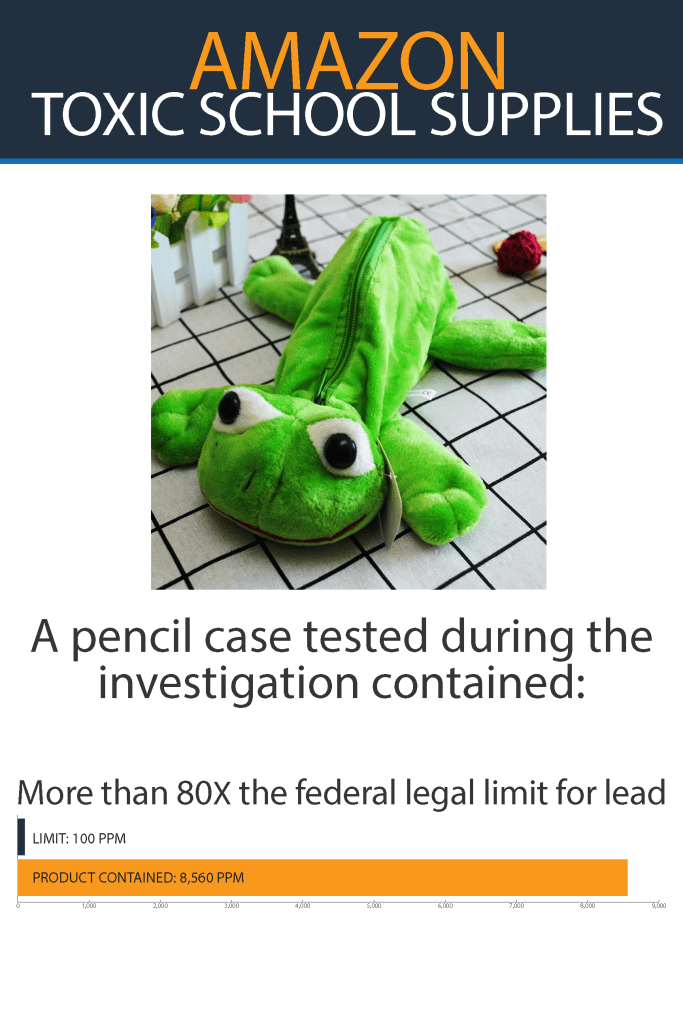
Here’s a recent example of Amazon getting into some trouble for being the platform for the sale of unsafe school supplies. In 2019, Attorney General Bob Ferguson from Washington state announced that Amazon agreed to block the sale of children’s school supplies and jewelry on Amazon.com without proof of safety testing after his office found high levels of toxic metals in school supplies sold on the site.
I can’t find a CPSC recall on any of these items, and wonder how many consumers actually knew about these recalled items. My guess is that a lot of these items are still in circulation, which is scary considering one of the items, an innocuous looking frog pencil case, tested at 80 times the limit for lead, at 8,560ppm.
The Seattle Times wrote:
Even after Amazon was notified of the illegal children’s products and said it had removed them, investigators found some of the same products again, as well as others that contained the metals at levels well beyond the legal maximum.
Amazon vows safety reforms after Washington state AG finds toxic lead and cadmium in children’s products, Seattle Times, 2019
So this is where I start to have even bigger problems with Amazon. What systems were or are in place to prevent sellers from re-posting recalled or banned items? Who is vetting these items? What listings can I trust on Amazon at this point?
There are plenty of legislators who are on Amazon’s case for pretty much everything, you name it. Most pertinent to this post, Senator Dick Durbin (D, Illinois) and Senator Bill Cassidy (R, Louisiana) introduced legislation in 2020 to address third-party seller issues.
The INFORM Consumers Act directs online marketplaces to verify high-volume third-party sellers by acquiring the seller’s government ID, tax ID, bank account information, and contact information. High-volume third-party sellers are defined as vendors who have made 200 or more discrete sales in a 12-month period amounting to $5,000 or more.
The legislation instructs online marketplaces to order their high-volume third-party sellers to disclose to consumers the seller’s name, business address, email address, phone number, and whether the seller is a manufacturer, importer, retailer, or a reseller of consumer products.
INFORM Consumers Act Press Release, 3/11/2020
Great but what about all the lower volume sellers? Legislation like this could be misleading to consumers, in my opinion. How are consumers supposed to know which sellers are covered by this law? Or that this law even exists? Most people don’t pay attention to these issues. They’re trying to LIVE. Who has time for extensively vetting everything they buy? The answer: almost no one. Not to mention, there’s no real way to actually vet anything. Companies and manufacturers don’t have to prove anything to consumers, or share safety testing reports, etc. Consumers have limited means to evaluate products.
Online shopping is mostly a leap of faith.
UPDATE: Amazon (and others) successfully lobbied to keep the Inform Consumers Act out of a bipartisan bill to counter China’s global rise. It was included because much of the problematic merchandise on Amazon comes from China. Including fake COVID-19 vaccination cards.
In a potential win for consumers, a panel of appellate judges in California decided that Amazon can be held liable for harmful products sold by third party-sellers, despite Amazon’s assertion that they are just a platform, not a retailer. How it plays out remains to be seen.
More recently, Amazon blocked a ton of fake stuff from being listed. Like 10 billion listings. Which is great, but doesn’t make me want to shop there. I could go on and on about Amazon, like how they are pushing back on legislation to force online retailers to indicate where things are made. The fact is it’s the Wild Wild West on there, a lot of cheap, possibly unsafe products from China, and I’m not comfortable with it. I’m taking my money elsewhere, as much as I can.
There’s also their treatment of workers, Jeff Bezos as the new Lex Luther, and a whole bunch of other reasons to not frequent Amazon. This guy is going to space and buying a $500 million yacht, when he could probably do a lot of good with his ill gotten fortune–if he gave a shit.
Ultimately, I concluded I’m not particularly comfortable shopping at Amazon anymore.
But I still shop there, sometimes. Mostly for books, if I can’t find them elsewhere. Never for kids stuff (clothes, toys or otherwise). I do shop at Whole Foods. We have Ring. It feels impossible to completely escape Amazon, as the internet can attest to, but I try. I’m not alone. Other’s have tried to quit Amazon, and found it to be impossible.
One thing that has been especially difficult is trying to keep questionable Amazon products gifted from others out of my home. Birthday party favors, school prizes, toys and gifts for my kids…how do you tell everyone in your life, please don’t buy us random third party stuff from Amazon, I don’t trust it? Haven’t figured this one out yet. One solution was to make our own prize bag for trade-ins when something super questionable comes home. Which can be a massive bummer for kids who want to be a part of things with their peers. I manage some of this by staying informed of toy recalls and keeping an eye on CPSC data. And just letting my kid keep some stuff for awhile until it’s time to purge the toys.
And, sometimes finding a product in an actual store, OR sold directly from a brand like Target (instead of a third party seller) proves impossible. Walmart and Target both have their own third party seller marketplaces to worry about.
For now, I choose to not buy from third party sellers. I try to buy direct from companies, in person if possible. If I shop on Target.com, I make sure I’m buying from Target–not that it’s any guarantee, but it makes me feel some reassurance I guess.
Ultimately everything is “buyer beware”. So, I’m wary. We can’t wait for regulations. Too many people are against regulations. It’s not the path. And in my opinion, we can’t trust companies to do the right thing either. See: Fisher-Price inclined sleepers. I’d love to see consumers, especially parents, use their money in ways that shift the market. This calls into question a lot of issues about privilege–not everyone can afford to buy expensive wood toys and locally made organic onesies. For those of us with privilege and access, I believe we have an obligation to advocate for and purchase safe products, from responsible retailers, and to demand better for ALL kids.
Parents have a lot more power than they think. We need to start using it.
 Kinda NonToxic