The short answer is, probably!
When I learned about lead in tile, both ceramic and porcelain, I immediately thought of the kitchen and bathroom renovations we did with a toddler living in our home. I felt SICK. And then, I felt angry. Angry at our contractors for not knowing and/or not advising us of the risks (they also didn’t test for lead paint, an egregious violation we didn’t know about at the time). Angry that this is not common knowledge and that millions of kids are likely exposure to lead via tile demolition (or lead dust coming home on the clothes of parents who work in construction). Angry that leaded tile continues to be installed in homes across the United States.
Yes, contrary to what some may tell you, lead glazed tile can be found in homes of any age.
So where is the lead? Glad you asked. For ceramic tile, the glaze is whatever the colorful layer is on top of the tile. There’s no way to know if the tile has lead unless you test it. Generally the tile becomes hazardous in three ways: when cut and installed, in heavily trafficked areas where the glaze is wearing away, and most importantly, during demolition.
Here’s how I tested my ceramic tile:
1. I had a licensed lead inspector come over and scan the file with an XRF machine. For one type of tile the results were somewhere between 1.2-1.6 micrograms per centimeter squared. Paint counts as lead based, according to the EPA, if it is 1 microgram per centimeter squared, which equals around 5000ppm lead. The other tiles in our home did not register any lead—however, a more sensitive XRF machine may pick up lead in them at lower levels.
2. I sent a piece to an EPA accredited lab to be tested for lead. I don’t remember the results but basically the tile had lead. This is not the method to use. It gives an incomplete result about the amount of lead in the glaze, because they are measuring the total amount of lead in the piece of tile, which is diluted by the ceramic.
3. I demolished two pieces of tile and did dust wipe samples of the surface of the tile to see what the lead dust levels may be. The results were around 32 ug/sqft and 13 ug/sqft, both of which are over the recommended standard for lead dust floor clearance of 5 ug/sqft.


Basically, we have a problem on our hands when we need to replace the tile.
After speaking with two lead abatement professionals, we determined that the cost will be astronomical. We were advised not to be living in our home when we remove the tile, and basically to move all our things out of the home so they don’t get contaminated—especially soft furnishings. We are not to move back IN to our home until we’ve thoroughly cleaned and tested the home for lead dust.
So, yeah that sucks. But what sucks even more are the stories I’ve read of kids being poisoned during home renovations from tile demotion. I actually saw a post from one mom who said her family moved into a new home and her son was poisoned from lead dust in her master bedroom carpet, left over from when the previous owners renovated their bathroom.
Really makes you wonder.
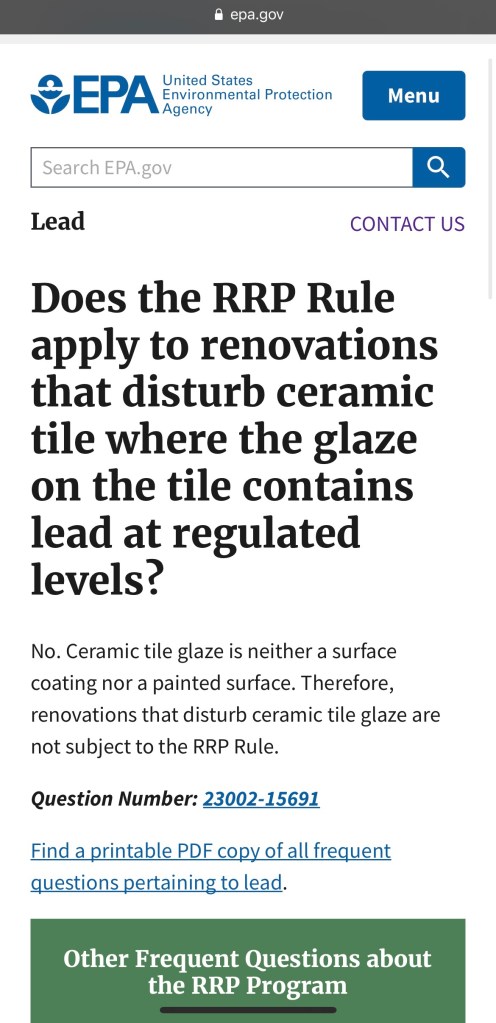
So what are the laws around lead in tile? I have no idea. I can tell you that the EPA basically says that ceramic tile is not covered under the RRP rule—the regulation that says contractors have to follow certain procedures in older homes (spoiler alert: most contractors don’t give a shit about this rule and don’t think lead is a thing). At the very least the RRP rule is unclear about tile.
What should you do?
Either have your tile tested with an XRF by a professional or assume that it’s leaded and treat it as such. While you are testing, test your bathtubs and porcelain sinks. Bathtubs can be a source of lead exposure for kids. Despicable, right?
And if your wheels are turning, and you’re starting to wonder about glazed ceramics in general…yes ceramic dishes and mugs often have lead in them, and the FDA says that is okay as long as they only leach a little bit of lead into your food. Insanity! More on that later…
A few resources:
Why ceramic tile shouldn’t be tested for lead (because you should assume they are leaded)
A contractor tries to warn the industry about ceramic tile lead hazards
 Kinda NonToxic